From online quizzes determining which Disney princess you are, to news reports regarding hurricane Dorian, BuzzFeed has it all. In recent years, the sensational website has been catching global attention. The young news medium has amassed an enormous following since its startup—and it’s no secret why. For years, BuzzFeed has drawn in online readers with the use of their clever clickbait and stimulating titles. This method of capturing readers is exactly what Nicholas Carr, the author of “Is Google Making Us Stupid?” fears is wrong with the internet. Carr insists that the internet is reprogramming our brains, embedding this system that values “‘efficiency’ and ‘immediacy’ above all else,” training us to “zip along the surface,” searching for “quick wins,” (Carr). Conversely, Kathleen Fitzpatrick, author of “Reading (and Writing) Online, Rather Than on the Decline,” asserts that the internet is a wonderful medium that fosters engagement, collaboration, and “Can undoubtedly help produce… clearer thinkers in any venue,” (Fitzpatrick 46). While Carr neglects to consider the positive contributions the internet holds, Fitzpatrick danced with them, ultimately proving why websites like BuzzFeed are enhancing our learning, not making us dumber.
As mentioned before, BuzzFeed is no stranger to clickbait—it’s how they pull in their readers. Because of these enticing thumbnails and tempting titles, readers are commonly bouncing from article to article. Carr fears this “bouncing,” as we are no longer “reading in the traditional sense,” observing that, “people using… sites… typically read no more than one or two pages of an article… before they would bounce to another.” Adding that, “when we read online… we tend to become… largely disengaged,” (Carr). However, Fitzpatrick would strongly disagree with that assertion. BuzzFeed hardly, if ever, posts articles that are more than a couple of paragraphs long. Gone are the days with hours spent sifting through piles of books for a single statistic or detail, and BuzzFeed gets this. They keep their articles concise and interesting, even providing opportunities for readers to respond and react. Fitzpatrick notices this, observing that, “Readers expect to be able to comment on what they read.” Moreover, “Readers expect the author to respond as well,” (Fitzpatrick 45). This breeds an interactive relationship with the author and readers, supporting Fitzpatrick’s argument that digital media is an engaging medium that enhances learning.
BuzzFeed is also notoriously known for their quizzes, namely: “This Sorting Quiz Will Tell You Which Hogwarts House You Truly Belong In,” “Plan Your Ideal Date And We’ll Reveal Which Dog Breed You’re Most Like,” and more (Francois). These quizzes are funny, engaging, and popular; so popular, in fact, that entire communities have formed. The Hogwarts house placement test, for example, has comment sections littered with strangers coming together as if they are now family bound by blood (Bate and Curry). As Fitzpatrick put it, “This community is ready with congratulation and sympathy and is eager to share jokes and memes, but it’s also ready to debate, to discus, to disagree,” (Fitzpatrick 47). It is silly to imagine that strangers can come together and converse the way these online mediums have encouraged them too, however, that’s exactly what scholars are doing today. Fitzpatrick goes on to say that, “Online texts often become a pretext of sorts for discussion with friends, colleagues, and other readers,” (Fitzpatrick 45). This suggestion of collaboration further turns the tide against Carr’s argument about being disengaged while reading online (Carr). Obviously, with all the commotion, it may be difficult to suggest that many collaborating readers are “disengaged.” BuzzFeed has already shown us how it encourages engagement and collaboration with silly My Little Pony quizzes alone—so how can the rest of BuzzFeed enhance our learning?
Up until this point, this essay has touched mainly on sillier examples that BuzzFeed presents, however, the aforementioned methods apply even in the BuzzFeed News sections—the real news. At the end of the day BuzzFeed is also a news medium that presents legitimate and credible information. BuzzFeed News certainly has made a name for itself, having won the National Magazine Award, the George Polk Award, and narrowly missing out on a Pulitzer Prize (Mullin). This form of instantaneous information is something that even Carr can appreciate, admitting that, “The Web has been a godsend… as a writer. Research that once required days… can now be done in minutes,” (Carr). BuzzFeed is constantly being updated with new and relevant stories, and to echo what Fitzpatrick said, BuzzFeed is allowing scholars to, “Engage in complex conversation in real time, with many colleagues,” (Fitzpatrick 47). This further fosters engagement and collaboration, but now we see it with relevant and important information.
BuzzFeed, no matter how strange or silly the context of its posts may be, manages to join the ideas of both Carr and Fitzpatrick into one space. Yes, BuzzFeed may be riddled with clickbait and tasty titles, encouraging superficial exploration that Carr detests, but even so, Fitzpatrick would argue that it teaches great lessons in engagement and collaboration. When observing BuzzFeed News, you find a medium where scholars can thrive. In her essay, Fitzpatrick mentions “Facebook and Twitter and Tumblr,” as examples where digital media can enhance learning (Fitzpatrick 46). BuzzFeed is just another asset that could be added to the bunch, as it enhances learning in the lessons it teaches about collaboration and engagement.
Work Cited
Bate, Ellie, and Paul Curry. “What Is Your Hogwarts House Percentage?” BuzzFeed, BuzzFeed, 11 Sept. 2019, https://www.buzzfeed.com/eleanorbate/accurate-af-sorting-quiz.
Carr, Nicholas. “Is Google Making Us Stupid?” The Atlantic, Atlantic Media Company, 13 June 2018, https://www.theatlantic.com/magazine/archive/2008/07/is-google-making-us-stupid/306868/.
Fitzpatrick, Kathleen. Reading ( and Writing ) Online , Rather Than on the Decline.
Francois, Nikki. “Here Are 61 Of The Best Quizzes Of The Year.” BuzzFeed, BuzzFeed, 4 July 2019, https://www.buzzfeed.com/nicholefrancois/best-quizzes-2018.
Mullin, Benjamin. “Digital Digging: How BuzzFeed Built an Investigative Team inside a Viral Hit Factory.” Poynter, 20 Mar. 2016, https://www.poynter.org/tech-tools/2016/how-buzzfeed-built-an-investigative-team-from-the-ground-up/.
Pledged: MS
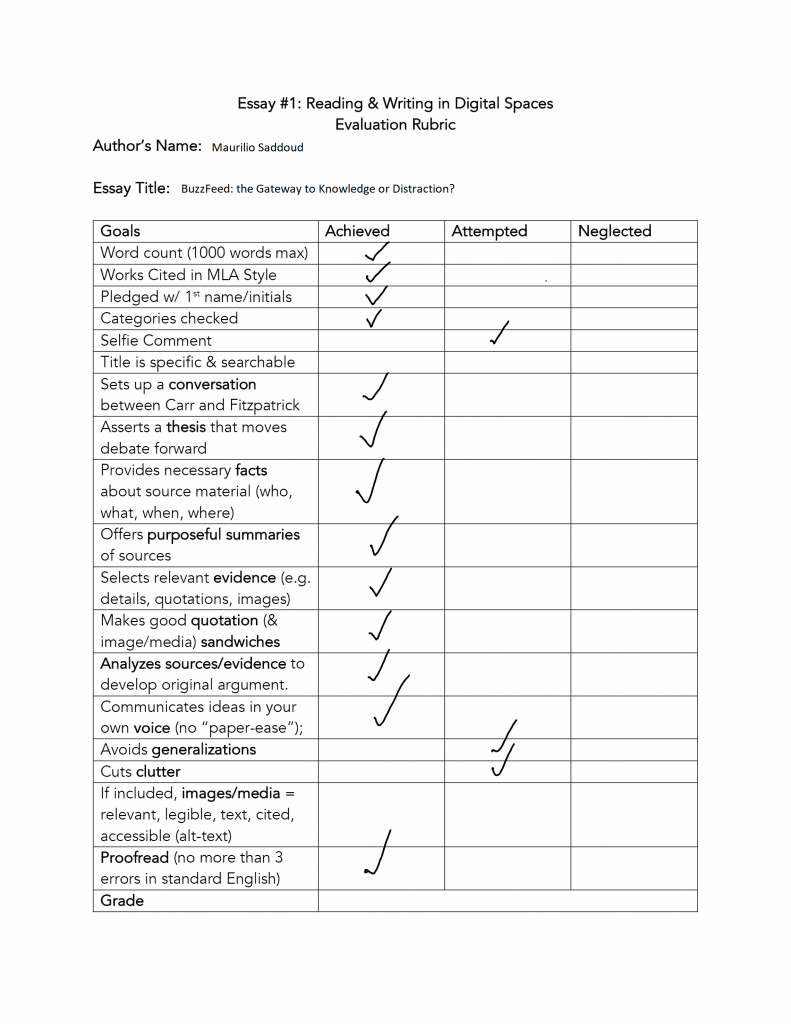

Wow, Maurilio, this essay is leaps and bounds ahead of the first draft in terms of the specificity, depth, and persuasiveness of its argument. You worked hard to revise holistically, incorporating details and examples from Buzzfeed to bring fresh evidence and insight to the debate. You made a smart decision to start with the more enticing Buzzfeed and then frame your example in the context of the debate between Carr and Fitzpatrick, and you do a terrific job incorporating their voices into the conversation through well chosen quotations, so that the entire essay feels like a lively, engaging conversation. You deliver a clear, compelling thesis that Buzzfeed not only provides entertaining distractions, but also enhances learning, and you develop this thesis with relevant subclaims: 1) that click bait fosters interactivity, 2) that quizzes generate community, and 3) that Buzzfeed serves up real, serious news. While the 5-paragraph structure might look like the traditional h.s. format, it transcends that template because your sub-claims develop and complicate the thesis, rather than just fill 3 buckets with 3 examples of the same thing.
You do a fine job integrating ideas from Carr and Fitzpatrick into your discussion of each aspect of Buzzfeed, showing how their seemingly contradictory arguments are both true and relevant to this platform. In fact, so seamlessly do you integrate them that it often seems like they are talking about Buzzfeed, when they aren’t. I think the argument would benefit from some acknowledgment that, however, interactive, communal, and informative Buzzfeed is, it’s not a scholarly platform and, as far as I know, it’s not a place where scholars “Engage in complex conversation in real time.” By acknowledging the differences between Buzzfeed and more traditional scholarly platforms, you create the possibility for asking: what would a scholarly equivalent of Buzzfeed be? The essay also quotes Fitzpatrick saying, “Readers expect the author to respond as well,” but do Buzzfeed authors ever respond to their readers? Or do readers just talk amongst themselves?
The moral of this story is: once you set up conditions of sameness, as you so deftly do, showing how Buzzfeed matches Fitzpatrick’s claims, you are in a position to make the most of more nuanced and precise differences. Rather than just “adding Buzzfeed to the bunch,” you can help delineate similarities as well as differences, so that “the bunch” can be differentiated and improved upon.
Forgot to mention 2 things:
1) quotations are seamlessly woven in, but sometimes without necessary sandwiches, as in the second paragraph, e.g.:
Carr fears this “bouncing,” as we are no longer “reading in the traditional sense,” observing that, “people using… sites… typically read no more than one or two pages of an article… before they would bounce to another.” Adding that, “when we read online… we tend to become… largely disengaged,” (Carr). However, Fitzpatrick would strongly disagree with that assertion. BuzzFeed hardly, if ever, posts articles that are more than a couple of paragraphs long.
There’s at least one slice of bread missing here, and possibly also an entire sandwich. Can you tell where?
Please change your settings so I don’t need approval!