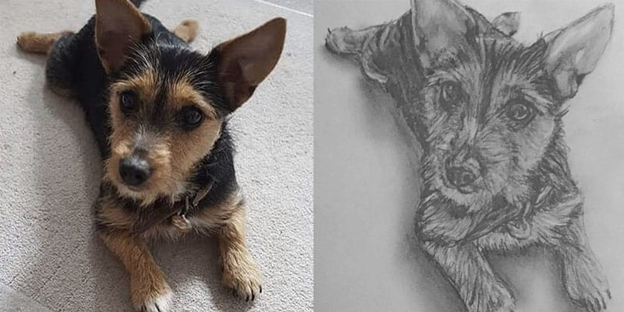
This is a photograph— and this is a drawing.
There is a clear distinction between the two: one is a photo of an actual dog and the other is a drawing of a photo. Despite the distinction, both pictures seem to portray the same image, although, I am sure one took much longer to create than the other. Photographs take no time at all—click, done. However, drawing require much more, labor, attention, and time; and even so, photographs will always result in a more detailed picture. With photo documents readily available, wouldn’t authors opt into the faster, more detailed method, rather than recreating documents themselves? Art Spiegelman sure did. In his award-winning graphic novel, Maus, Spiegelman has snapshots sprinkled throughout. One example being a photo of his brother, Richieu (Figure 1).
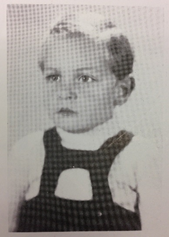
However, what if an author doesn’t choose the path of least resistance? What if an author decides to painstakingly recreate every archived photo, letter, diary entry, or map that they include in their book? That is exactly what Alison Bechdel did throughout her graphic memoir, Fun Home. This book follows Bechdel’s story as she is becoming a woman who discovers her own lesbian sexuality, while at the same time, coping with the recent death of her father, a closeted homosexual who let out a swarm of secrets after he presumably committed suicide. Bechdel brilliantly addresses many heavy topics throughout her graphic memoir with her satirically comedic tone, while showering the reader with almost one thousand panels of incredibly illustrated artwork. This artwork has taken the form of the narrative, and it’s also taken the form of secondary sources: photos, letters, diary entries, maps. In sacrificing time and detail, Bechdel is recreating these documents in order to remind readers that we are the witnesses of Bruce’s secrets, to add weight to each document, and to engage the question: what does it mean?
On pages 100 and 101 of Fun Home, there is a large drawing of a photograph with a hand holding it (Figure 2).
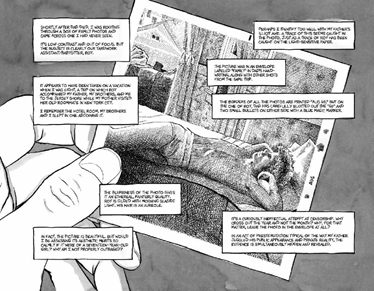
The photograph is a drawing, rather than a photocopy of the picture. The reader’s eyes are also drawn to the hand. This is no mistake. Bechdel masterfully portrays her perception of the photograph to the reader, placing them in her point of view. In doing so, she is reminding the audience that this is evidence she had come across. Proof that the stories about her father’s homosexual encounters were true. Ann Cvetkovich, author of “Drawing the Archive in Allison Bechdel’s Fun Home,” notices this as well, adding, “there is a witness here,” agreeing that Bechdel uses the power of the graphic medium to bring life to these outdated documents, making them relevant in the now. Cvetkovich and Bechdel both acknowledge that Bruce’s secrets are out for the world to witness, which is conveyed by Bechdel’s hand drawn reproduction of the photograph.
Bechdel also makes the extra effort to reproduce these documents in order to add a layer of emotional weight and investment. Her stumbling upon this photograph of her childhood babysitter, Roy, must not have been easy. She does mention in her novel that she was not upset by this, however, this is just one example of many. For Bechdel to go back and uncover all these secrets is a testament to how strong she is, not only as an author and researcher, but as a human and a daughter. Many of the pieces of evidence she uncovered couldn’t have been easy for her to see, and she doesn’t just stop there. Bechdel traced, copied, analyzed, and recreated all but one of her documents of evidence. As a reader, this results in a more fulfilling read, as I am able to appreciate the hard work that Bechdel did not have to put herself through. In doing so, she adds weight to her sources, becoming more than just evidence. This evidence is now a part of her, another one of her creations or artworks. Cvetkovich also agrees that Bechdel’s, “sustained attention to the object… reinforces her attachment to it,” further bolstering the idea that in recreating these documents, Bechdel is attaching weight to these documents that wouldn’t otherwise be there had she simply photocopied them.
Many authors who include evidence within their works typically do so by photocopying the documents into their medium. Bechdel breaks from the norm in this sense by recreating her source evidence and drawing them by hand in her graphic memoir Fun Home. Bechdel is a talented artist, and although her recreations do an incredible job of resembling the primary sources, they also go on to further remind the reader that there is a witness, as well as creating this deeper appreciation that underscores her resilience and emotional bond with the evidence she sites. Had these documents simply been photocopied, they wouldn’t nearly have the same impact on readers.

In this essay, you do a good job of incorporating your evidence into your argument, in the form of both quotes and images. Aside from Speigelman’s image in your intro, all of your evidence is effectively placed into sandwiches of analysis that clarify why they are significant to your claim. None of the evidence feels out of place, and I wasn’t left wondering why you chose to include it. Also, the photos of the dog were a good hook to start off with because it made me want to keep reading to find out how you were going to connect that to the topic of Fun Home. In terms of something to work on, your claim, that “Bechdel is recreating these documents in order to remind readers that we are the witnesses of Bruce’s secrets, to add weight to each document, and to engage the question: what does it mean?” lies on the assumption that these results were intentional on her part. Even though the painstaking time and effort that Bechdel put into her illustrations may have had these effects, we have no way of knowing if they were on purpose. Try rewording your claim so that the effect of her artwork comes from your personal observations, rather than assuming Bechdel’s goals. As I mentioned earlier, the image from Spiegelman’s novel is missing analysis on the back end. If you choose to leave this example in your final draft, this could be a great time to incorporate a “they say” into your argument. Since your claim is that drawn images are more meaningful, take this chance to voice the thoughts of authors who felt that photographic images were better, and why they fit those situations better. It could be a good place to set up a critical conversation that is carried out during the rest of the essay.
Hey Maurilio! I didn’t want to give you the same feedback as before, so on my second read through of your essay I tried to consider your new thesis to see what parts of this first draft could still be utilized. Instead I ended up really considering your structure instead. I definitely think that what Dr. Churchill suggested about including two images of Bechdel at the beginning would be excellent, and more specifically, I think you should either utilize the same images from the New Yorker (Thurman’s article, https://festival.newyorker.com/tickets/alison-bechdel-talks-with-judith-thurman/ ) or choose a panel from Fun Home! Either way, it would be a good way to tie into critical discussion, be it about Thurman’s article or about Fun Home itself! Further, I think an interesting way to symmetrically close your argument would be to use whichever duo you did not use previously! By that I mean if you used the New Yorker, go for Fun Home and vice versa! It might not work out, but I feel like it brings up interesting points about how Bechdel portrays herself in different scenarios of power in her life, be it her childhood or adult life.
In terms of what to keep from this first draft, I’m in love with the idea of “witness” that you take from Cvetkovich and I hope you continue to weave that concept in to your next draft! I think that it is a really powerful takeaway from your essay, and I think it would be only a minor adjustment to implement it in your essay.
We definitely covered a lot of things earlier in peer review that I hope were helpful, these are just my thoughts on my second read-through! I really enjoy reading your essays, I think you have a great energy and flow in your writing!