In 2015, Walmart made a profit margin of 3.1% (Perry), whereas American pharmaceutical companies “have had annual profit margins of 40%” (Schewe). What we are witnessing here is an unexpected disparity between the world’s largest retailer and a couple of no-name pharmaceutical companies. This disparity is possible with the power of Big Pharma, a multibillion-dollar system of unchecked, FDA approved monopolies (Kesselheim). A monopoly is “a firm that is the only seller of a good or service and does not have a close substitute” (Hubbard 326). Monopolies are how Big Pharma has achieved such dazzling profit margins. Big Pharma was born in the years following WWII, as “the discovery of penicillin accelerated [the] development of therapeutic drugs” (Schewe). WWII set off an explosion of medical and chemical research, and this explosion of research set off an explosion for profit. These companies maintain their monopolies because “new drugs receive 20 years of patent protection and 5-7 years of exclusivity” (Schewe). This means that the only people who can manufacture these drugs are the pharmaceutical companies that own the patents. As such, at the turn of the century, “the total revenue share from prescription drugs increased from 32%… to 83%” (Schewe). As Big Pharma grew, so did its potential for profit.
Interestingly enough, in the years that Big Pharma has grown, so have the incarceration rates of the mentally ill. Bryan Stevenson also notices this increase in his book Just Mercy. Stevenson’s book is about racism within the justice system but is also equally about the mass incarceration and treatment of the mentally ill. Stevenson claims that “today, over 50 percent of prison and jail inmates in the United States have a diagnosed mental illness, a rate nearly five times greater than that of the general adult population” (Stevenson 188). Big Pharma has been growing, and uncoincidentally, so have the incarceration rates of the mentally ill. I am not suggesting a false syllogism in this essay—that because Big Pharma and the incarceration rates of the mentally ill grew at the same time, they must be connected. Instead, I aim to analyze the economic impact of Big Pharma and highlight an aspect that Stevenson dismisses when determining who to blame for the mass incarceration of the mentally ill.
Because the incarceration rates have increased, Stevenson calls prisons “warehouses for the mentally ill” (186). He explicitly blames the court and justice systems for the mass incarceration of these people, asserting that “mass incarceration has been largely fueled by… excessive sentencing… of poor and mentally ill people” (186). Though Stevenson confidently blames the justice system in the previous quotation, I find it interesting that he includes the word “poor.” Is Stevenson suggesting a correlation between the poor and the mentally ill? He suggests this link again on a later page, saying that “the ‘free world’ became perilous for… poor people suffering from mental disabilities” (188). Stevenson senses a connection, as he hints toward this relationship multiple times, and he is not alone.
Emily Sohn, author of “Can Poverty Lead to Mental Illness,” also analyzes the correlation between these people. She claims that, “of 115 studies that spanned 33 countries… nearly 80 percent of the studies showed that poverty comes with higher rates of mental illness” (Sohn). Sohn’s findings inform us that poverty can lead to mental illness, but Dean Barnett, the author of “Mental illness and poverty,” shows us that this is a two-way street. Barnett is also interested in the link between mental illness and poverty, and his response to Sohn suggests a contrary conclusion altogether. He suggests that mental illness is a significant cause of poverty, citing that mentally disabled individuals have a “much harder time finding work, maintaining jobs, and taking care of themselves” (Barnett). Barnett tells us that mental illness can lead to poverty, but Sohn tells us that poverty can lead to mental illness—who is right? The truth is, they both are. Their findings suggest a back and forth relationship between mental illness and poverty—that one can cause the other, and vice versa—but what does this have to do with Big Pharma?
Thus far, I’ve shown that the incarceration rates of the mentally ill have increased and that poverty and mental illness are correlated. Yet, there is still something missing, a piece of the puzzle that doesn’t quite explain how or why the rate of incarceration has gone up. Enter Big Pharma, the previously mentioned monopoly on pharmaceutical drugs. Big Pharma effectively fuels the correlation between the poor and the mentally ill—who Sohn and Barnett have already shown us, can often be the same people. Big Pharma affects both poverty and mental illness directly, but to see how we must understand two things: elasticity and the price of drugs.
First, elasticity is the measure of responsiveness that consumers have to the prices of goods, responsiveness meaning a willingness to buy (Hubbard). The more responsive consumers are, the more elastic the product is. For example, if the price of a chocolate bar went up, fewer people would purchase this good because chocolate is not a necessity, making it elastic. Conversely, if little to no people respond to a change in the price of a good, that product would be considered inelastic. EpiPen, for instance, is very inelastic. The “inexpensive life-saving drug saw a price increase from about $100 to over $600 per package” (Kesselheim), and because this is a life-saving necessity, consumers had no choice but to spend.
Second, as seen above with EpiPen, the prices of drugs have increased dramatically in the United States. Daraprim is another example. This antiparasitic drug “increased its price 56 times to $750 per pill” (Schewe). The price of drugs continues to rise, and because Big Pharma is an unchecked monopoly, they have no reason to stop skyrocketing their prices for profit.
Now that we understand elasticity and that drug prices are rising, we can see how Big Pharma directly affects both the mentally ill and the poor.
Big Pharma is the only supplier of the prescription medication that mentally disabled individuals need. These medications are intended to ease the quality of life, and because they are a necessity, they are considered inelastic. As such, the mentally disabled are put in a position where they must pay, regardless of price. Because these individuals must buy their medication regardless of price, Big Pharma is rapidly raising its rates. The price inflation of medication leaves less money for food, rent, clothes, etc., until eventually, the medicine becomes too expensive. These individuals must then choose between entering poverty or letting their illness go untreated, as “cost is the most commonly reported barrier to using mental health services” (Kamal), as shown below.
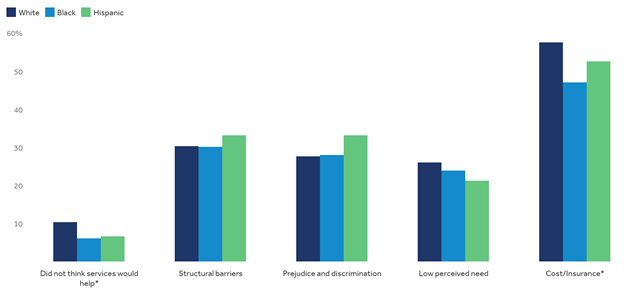
This graph tells us that over 50% of all people not using mental health services do so because they cannot afford them (Kamal). And eventually, as Sohn and Barnett have taught us, these individuals can end up with both mental illness and poverty, completing the cycle that Big Pharma feeds.
Though Bryan Stevenson blames the justice system for the mass incarceration of the mentally ill, even he acknowledges the problems born from the ultimatum depicted above. Stevenson states that “the inability of many disabled, low-income people to receive treatment or necessary medication dramatically increases their likelihood of a police encounter that would result in jail time.” The inaccessibility of necessary medication is putting mentally ill individuals at a higher risk of incarceration. Pharmaceutical companies exist to provide medicines for people who need it. Yet, Big Pharma exists solely to make a profit. Big Pharma prevents the mentally ill from accessing their medication, as well as encourage poverty due to price inflation. Though Stevenson acknowledges the problems that Big Pharma creates, he quickly dismisses it, pitting the blame against the justice system. Instead, I believe Big Pharma is to blame for the mass incarceration of the mentally ill. Big Pharma’s high prices fuel the correlations between the poor and the mentally ill, and because those individuals cannot afford Big Pharma’s prices, their illness goes untreated, and their risk of jail time increases. The simultaneous growth of Big Pharma and the incarceration of the mentally ill was not coincidental. Although Stevenson acknowledges Big Pharma, they play a much more significant role in the mass incarceration of the mentally ill than Stevenson accounted for in his book Just Mercy.
Work Cited
Burnett, Dean. “Mental Illness and Poverty: You Can’t Tackle One without the Other | Dean Burnett.” The Guardian, Guardian News and Media, 13 Dec. 2016, https://www.theguardian.com/science/brain-flapping/2016/dec/13/mental-illness-and-poverty-you-cant-tackle-one-without-the-other.
Hubbard, R. Glenn. Essentials of Economics. fifth ed., Pearson Australia, 2019.
Kamal Kaiser, Rabah. “What Are the Current Costs and Outcomes Related to Mental Health and Substance Use Disorders?” Peterson-Kaiser Health System Tracker, 31 July 2017, https://www.healthsystemtracker.org/chart-collection/current-costs-outcomes-related-mental-health-substance-abuse-disorders/#item-start.
Kesselheim, A S, et al. “The High Cost of Prescription Drugs in the United States: Origins and Prospects for Reform.” JAMA., U.S. National Library of Medicine, https://www.ncbi.nlm.nih.gov/pubmed/27552619.
Perry, Mark J. “The Public Thinks the Average Company Makes a 36% Profit Margin, Which Is about 5X Too High.” Aei.org, 2 Apr. 2015, https://www.aei.org/carpe-diem/the-public-thinks-the-average-company-makes-a-36-profit-margin-which-is-about-5x-too-high/.
Schewe, Eric. “How Did Big Pharma Get Big?” Https://Daily.jstor.org/, 19 Mar. 2017, https://daily.jstor.org/how-did-big-pharma-get-big/.
Sohn, Emily. “Can Poverty Lead To Mental Illness?” NPR, NPR, 30 Oct. 2016, https://www.npr.org/sections/goatsandsoda/2016/10/30/499777541/can-poverty-lead-to-mental-illness.

Leave a Reply