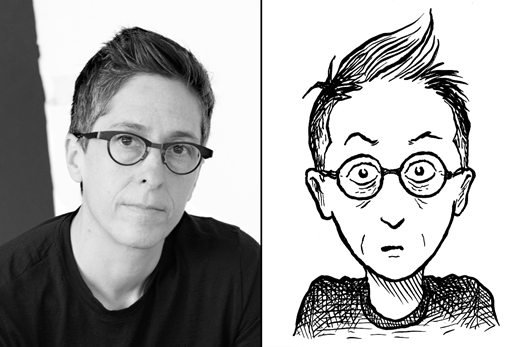
This is a photo of Alison Bechdel— And this is a drawing.
Clearly, there is a disparity here: one tells a black and white history, while the other incorporates style and character. The same style and character that Alison Bechdel incorporates in her graphic memoir, Fun Home. Bechdel’s creation follows her story as she becomes a woman, discovering her own lesbian sexuality, while at the same time, coping with the recent death of her father, a closeted homosexual who let out a swarm of secrets after he presumably committed suicide. Her story hinges on the fact that she is coming to terms with her sexuality, and as such, Fun Home can be viewed as a queer history of sorts. In fact, that’s just what Ann Cvetkovich believes this book to be. In her article, “Drawing the Archive in Alison Bechdel’s Fun Home,” Cvetkovich asserts that “Fun Home dares to claim historical significance and public space… for a lesbian coming-out story,” (Cvetkovich). While I agree that Fun Home has claimed “historical significance and public space,” I am not convinced that it “dares” to do so. Returning to the image overhead, the dichotomy between photographs, and the drawings Bechdel illustrates for her memoir, emulates her attempts to take hold of the narrative. In doing so, Bechdel intends to make this her own story, rather than to solely claim historical significance in the form of a public queer history as Cvetkovich suggests.
Newspapers, encyclopedias, and history books, if readily available, all use photographs to document and inform the public. Here is an example from GoPride.com.
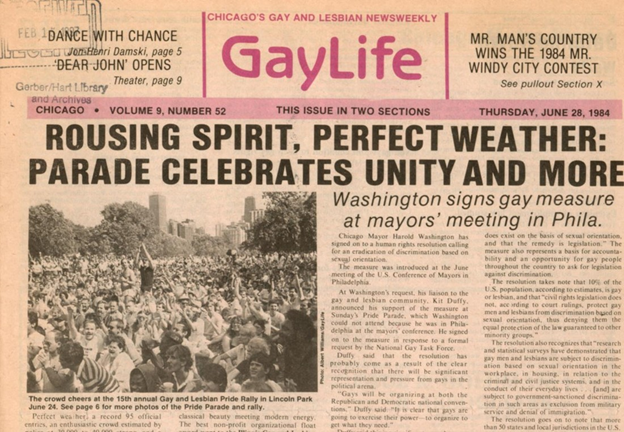
As you may notice, this newspaper cover, documenting a pride parade in Chicago from 1984, contains a photo—a photo that captures the events the way they unfolded, a black and white history. Photos are used for documentation, not drawings. As such, we begin to ask: if Bechdel truly intended to produce a public history of her queer coming-out story, aligning with Cvetkovich’s argument, then why is it that we do not see a single photograph throughout any of the 232 pages in Fun Home?
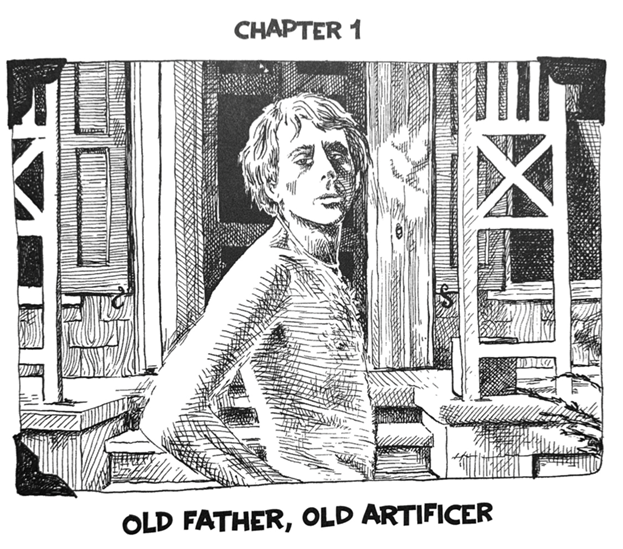
There is not a single photograph in this memoir that Bechdel didn’t hand draw herself—not even the family photos that prelude each chapter as shown below.
Conversely, Art Spiegelman had no problem including photographs in his graphic novel, Maus, including a photograph of his brother, Richieu (Spiegelman).
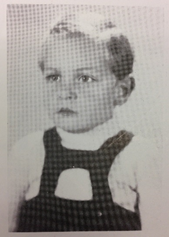
Despite this disparity, Cvetkovich draws many parallels between Bechdel and Spiegelman’s works, opening her article by, “Placing Alison Bechdel’s Fun Home alongside… Art Spiegelman’s Maus,” (Cvetkovich). She already believes, as do I, that Maus has claimed its historical space as a WWII survival story, revolving around the recounts of Spiegelman’s father from the time he spent as a Jew in Auschwitz. As mentioned before, Cvetkovich attempts to argue that, like Maus, Fun Home portrays a public history; however, there are too many disparities for this to hold up. For starters, Spiegelman isn’t telling his own story in his graphic memoir, and rather, it hinges on his father’s history. Cvetkovich even admits that, “Spiegelman strategically places… a photograph of the dead brother Richieu, whom [Spiegelman] never knew,” as pictured above. Spiegelman is telling a history, while Bechdel is telling her own story. The fact that he includes a photograph of a brother he never knew, portrays precisely why Maus is a public history, unlike Fun Home, in which Bechdel takes control of her narrative and tells her own story.
But how does she tell her own story? How do Bechdel’s recreations enable her to do this? They’re just drawings, right? In a sense, yes, but because Bechdel took these real-life photographs and recreated them by hand, she is essentially making them her own, physically and rhetorically. After Bechdel has drawn an image, that drawing becomes a piece of artwork, artwork that she created, artwork that belongs to her. Rhetorically, Bechdel snatches the photographs out of the public space and recreates it to fit her story and own her narrative.
In addition, Bechdel doesn’t just recreate the photographs, she also recreates all but one archived document, as she admits in an interview with Hillary Chute, “It’s all very carefully traced and redrawn. Except for one very small bit of actual childhood handwriting that I just scanned in a moment of laziness,” (Chute). Shown below is the “very small bit of actual childhood handwriting” Bechdel left in her memoir.
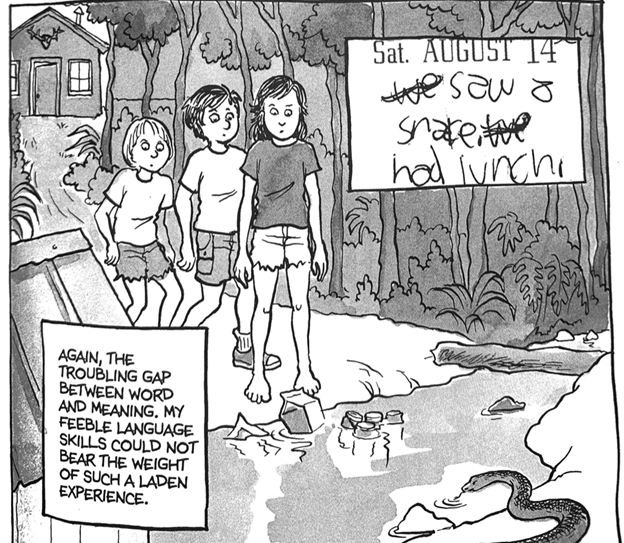
Although this may serve as evidence that this archive in the memoir portrays a history, it still belongs to Bechdel, being taken right out of her own childhood diary. Bechdel went through the effort to painstakingly recreate, not just the photographs, but also the letters, diary entries, and maps found in Fun Home (Chute). In redrawing the map that traces her father’s birth, to her father’s burial, she literally snatches this piece of public history—the map—something that you, the reader, and I, the writer, can both access online in a matter of minutes, and makes it her own, as it is now artwork on display in her story as shown below.
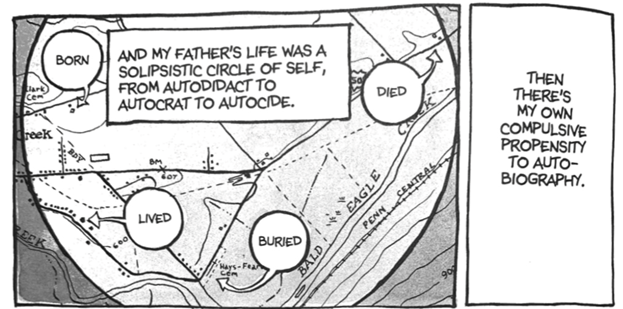
Bechdel took the archives and evidence, redrew them, and in doing so, took ownership of her artwork and made it her own. Had Bechdel simply scanned the map into her memoir, it would be just as much her history, as it would be anyone else’s who lives in that area. Bechdel’s recreations allow her to set herself apart from public history, enhancing her efforts to tell her own story.
In all reality, Cvetkovich’s idea that Fun Home could be a public history, with all the archived evidence it contains, is not entirely impossible. Through Bechdel’s success of her memoir, she certainly does, as Cvetkovich asserts, “provide a queer prospective that is missing from public discourse,” (Cvetkovich). But because Bechdel recreated the archived photographs, letters, diary entries, and maps, making them her own artwork, she snatches the evidence from the public history and molds it to tell her story, rather than revealing the black and white history that Cvetkovich suspects she is doing.
Bibliography:
Bechdel, Alison. Fun Home: a Family Tragicomic. Houghton Mifflin, 2015.
Chute, Hillary L., and Alison Bechdel. “An Interview with Alison Bechdel.” MFS Modern Fiction Studies, Johns Hopkins University Press, 22 Jan. 2007, https://muse.jhu.edu/article/209132/pdf.
Cvetkovich, Ann. “Drawing the Archive in Alison Bechdel’s Fun Home.” WSQ: Women’s Studies Quarterly, The Feminist Press, 2 June 2008, https://muse.jhu.edu/article/238092.
“Gay Chicago Rewind: History of the Chicago Pride Parade.” ChicagoPride.com, http://chicago.gopride.com/news/article.cfm/articleid/59118489.
Spiegelman, Art. Maus. Pantheon Books, 1992.
Thurman, Judith, and Alison Bechdel. “Alison Bechdel Talks with Judith Thurman.” The New Yorker Festival, https://festival.newyorker.com/tickets/alison-bechdel-talks-with-judith-thurman/.
Pledged: MS

This essay offers a bold, original argument, which is animated by your lively, energetic style of writing. I love the opening, with the arresting, sophisticated juxtaposition of photograph and drawing. You create a sense of real debate, and do a nice job providing evidence to support your central claim that Bechdel aims to share a personal story, not a public history.
The argument would be more persuasive if the claims were refined to be ones of degree rather than kind. The differences between you and Cvetkovich, and between Bechdel and Spiegelman, seem exaggerated. Cvetkovich doesn’t argue that Fun Home is solely a public history, but rather, asserts that that the graphic memoir lends legitimacy and authority to a private, personal story by making it part of public, queer history. Similarly Maus is not solely a public history of the Holocaust; it’s also a very personal, intimate account of a father/son relationship. You can refine your claims by treating Cvetkovich more as an ally than an adversary. She says both Maus and Fun Home combine private stories with public histories. That’s true, and you want to make a subtle point of differentiation, on of emphasis or degree, rather than kind. While Fun Home combines private and public (you can’t deny the scenes of Stonewall for example), it puts more emphasis on private, particularly through the way Bechdel insists on redrawing all her archival artifacts, in order to emphasize they are artistic creations, not documentary evidence.
See Hypothesis for small suggestions for weeding out clutter.